Why the Same Case IH Fault Code Can Mean Something Totally Different on a Puma, a Magnum, and a Steiger
If you’ve worked on Case IH equipment across more than one product line, you’ve probably run into this situation: a fault code that has a clean, well-documented meaning on one tractor turns up something completely different, and sometimes almost contradictory, on another. It’s not a diagnostic mistake, and it’s not a broken database either. It’s just how Case IH structures its fault codes across platforms.
To actually understand why this keeps happening, you have to stop looking at the code number and start looking at what’s generating it.
The Code Number Isn’t the Whole Picture
At its core, a fault code is just a shorthand flag thrown by an electronic control unit when something it’s watching drifts outside acceptable limits. On its own, the number means nothing. What gives it meaning is which module fired it, what firmware that module happens to be running, and what exactly it was set up to monitor in the first place.
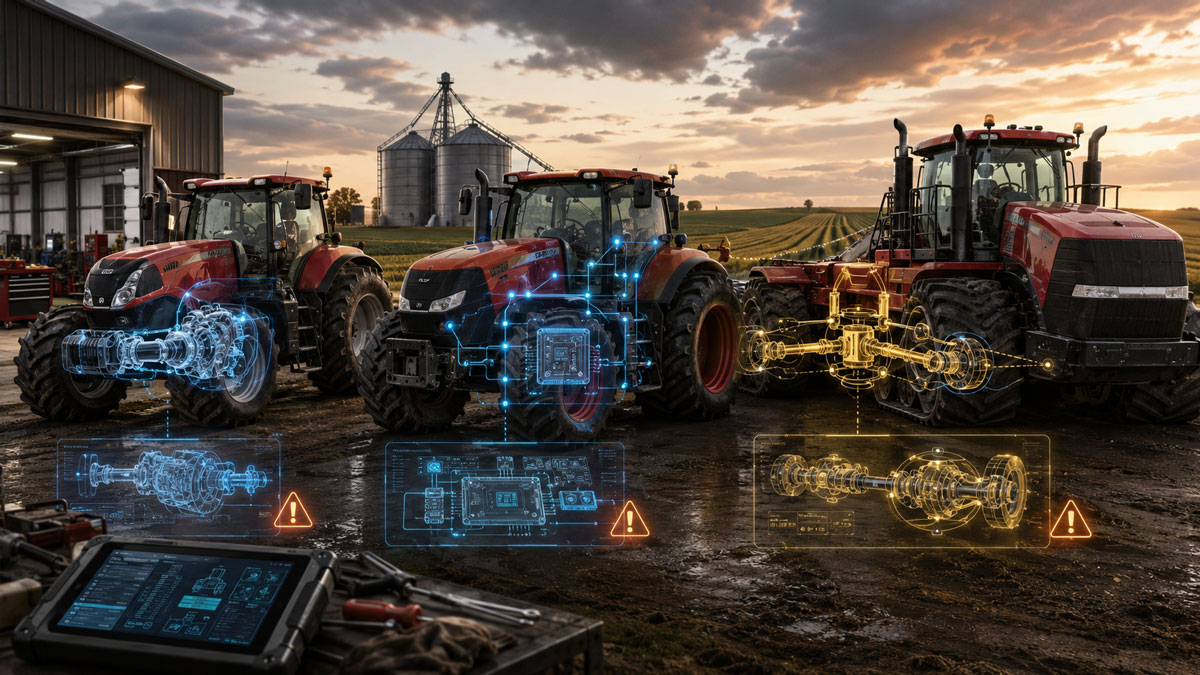
Case IH builds tractors across several very different platforms — compact and utility models, the mid-frame Puma line, the high-horsepower Magnum series, and the articulated Steiger four-wheel-drives. These weren’t all designed at the same time, they don’t share transmission architecture, and in a lot of cases they’re running entirely different generations of electronics. So yes — the exact same fault code can point to completely unrelated subsystems depending on which machine it showed up on.
Puma Fault Codes: The CVT Problem
Over the years, Puma tractors have come with several transmission options — standard powershift, semi-powershift, and CVT. And here’s the catch: case ih puma fault codes tied to the transmission control module reference completely different sensors and solenoids depending on which of those three you’re dealing with.
Take a “ratio control” fault as an example. On a CVT Puma, that’s meaningful — it maps straight to hydrostatic unit feedback. On a powershift Puma? That code might not even apply, or it could be repurposed for something unrelated entirely. Technicians pulling from a generic code list without first confirming transmission type end up chasing parts that literally don’t exist on that machine.
Magnum Fault Codes: It’s All About Controller Generation
The Magnum line has been through several major electronics overhauls since it first came out, and this is really where controller generation becomes the deciding factor. Case ih magnum fault codes from an older engine or transmission controller often follow a totally different numbering convention than codes from a newer, CAN-bus-integrated one.
Two things follow from that. First, a code pulled off a pre-Tier 4 Magnum’s display can point to a completely different failure than the identical number on a Tier 4 Final or Stage V unit — the controller software was rewritten in between, after all. Second, calibration updates rolled out mid-model-year can shift what a code is actually checking, even without any hardware changes at all.
Bottom line: model year and controller part number aren’t nice-to-haves when you’re researching a Magnum code. They’re basically mandatory.
Steiger Fault Codes: Articulation Adds a Whole New Layer
Steigers bring their own complications, mostly because of the articulated 4WD setup and the extra control modules needed for steering angle sensors, differential lock, and — on tracked models — undercarriage tensioning. None of that exists on a wheeled Puma or Magnum, obviously.
So when case ih steiger fault codes reference steering or articulation, there’s simply no equivalent anywhere else in the lineup. Cross-checking one of these against a Puma or Magnum code list either gives you nothing useful or actively misleads you. On top of that, Steiger drivetrains themselves vary — standard axle versus powershift high-horsepower builds — which again changes what a transmission code is watching.
Configuration and Firmware Make It Worse
Here’s another wrinkle: even two tractors of the identical model and model year can behave differently if they’ve got different optional equipment. Auto-guidance, a different hitch setup, an alternate PTO configuration — any of these can mean the controllers were programmed with different active fault code sets. Same hardware, different software behavior. A code that’s perfectly valid on one unit might not even be implemented on another.
Then there’s firmware. Case IH pushes calibration and software updates periodically, and those updates can renumber codes, merge them together, or reassign them altogether as part of a larger architecture shift. So a code list pulled from a five-year-old manual? It might not match a machine that’s since had its controller reflashed.
What This Means in Practice
Given everything above, treating fault codes like they’re universal across the whole Case IH lineup is probably the single biggest cause of misdiagnosis out in the field. Getting it right means confirming a few things upfront:
Which platform you’re on (Puma, Magnum, Steiger) and what transmission it’s running
The controller’s hardware generation and current firmware or calibration version
Whether optional equipment on that specific machine changes which codes are even active
Software tied specifically to that model and year — not some generic fault code chart pulled off the internet — is still the most dependable way to confirm what a code actually means on the tractor in front of you.
Wrapping Up
None of this confusion is a design flaw, really — it’s just what happens when one manufacturer supports this many platforms, transmission types, and controller generations at once. Puma, Magnum, and Steiger tractors were built on different timelines with different electronics, and their fault codes carry that history with them. Technicians who factor in model, controller generation, model year, and transmission setup before jumping to conclusions will land on the right diagnosis far more often than anyone relying on a single one-size-fits-all code list.