Case IH Transmission Fault Codes: Telling Sensor Trouble Apart from Hydraulic Pressure Problems
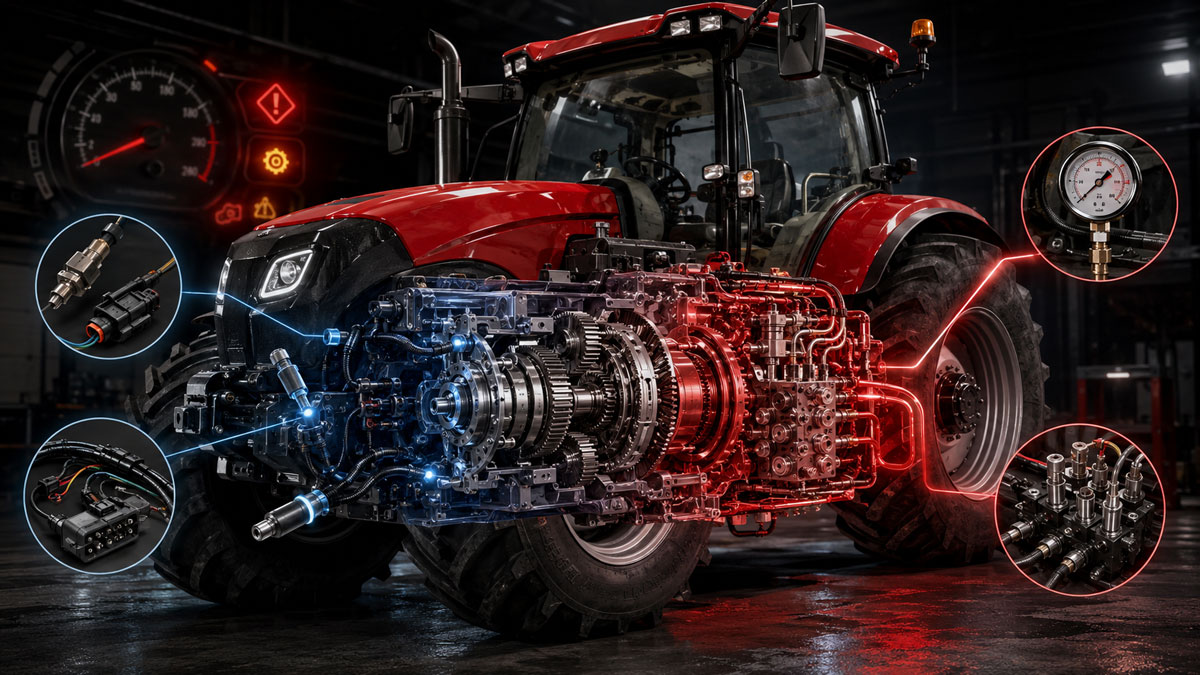
When a Case IH transmission throws a fault code, there’s a natural pull to read it as an instruction — swap this sensor, replace that solenoid, done. In the real world, that habit burns through parts budgets and produces a lot of repeat visits. A fault on a Powershift, CVT, or full-powershift setup, whether it’s a Magnum, Puma, or Steiger, is rarely one isolated component failing. It’s usually the tail end of a chain reaction. The skill that actually matters is tracing that chain backward — from the code, to the signal that triggered it, to whatever’s physically going on underneath.
This isn’t a code lookup table. It’s a way of thinking through what’s happening mechanically and electrically when a fault pops up, so you can figure out whether you’re looking at a cheap sensor fix or a serious hydraulic and mechanical problem before any wrenches come out.
Codes Are Vague on Purpose (Sort Of)
Here’s the thing — the transmission control unit doesn’t actually know what broke. It only knows what its sensors told it, and whether the system behaved the way it was supposed to. So a code reading something like “speed sensor signal implausible” or “clutch pressure below threshold” is describing a symptom the TCU picked up on, not naming a cause. That same code could come from:
A sensor that’s genuinely dead — open circuit, short, degraded output, take your pick
A wiring or connector issue sitting between the sensor and the controller
An actual hydraulic fault — low pressure, sluggish response, internal leakage — that makes a perfectly healthy sensor look like it’s lying
Something mechanical (worn clutch pack, chipped gear tooth, junk stuck in a valve) throwing system behavior off enough to cross a threshold
Which is exactly why techs with experience treat the code as a jumping-off point rather than a verdict. The whole diagnostic job comes down to figuring out whether the sensor’s lying to you, or telling you the truth about a genuinely bad situation.
First: Make Sure the Sensor Signal Checks Out
Before you go anywhere near hydraulics, confirm the sensor itself is reporting straight. Speed sensors — input, output, countershaft — are typically Hall-effect or variable reluctance units, and each one has a known-good signal signature: voltage range, frequency, duty cycle, all tied to actual shaft speed.
Pull up live data through Case IH’s EST software or a compatible scan tool and check the sensor’s reported value against something you trust — engine RPM cross-referenced to expected transmission speed, or a second sensor on the same shaft if the system has one for redundancy. A reading that’s flatlined, jumping around erratically, or just physically impossible (speed showing up while the tractor’s parked and PTO’s off) points toward the sensor or its wiring, not the hydraulics.
One habit worth building: test resistance and voltage right at the connector, not just back at the harness near the TCU. A sensor can pass every test on its own bench and still cause a fault because the connector pins are corroded, the harness is rubbing against something that moves, or a pin’s worked its way loose. Wiring problems tend to be intermittent — so if a fault clears after a restart but comes back once things heat up or start vibrating, that’s your wiring flag, not a bad component.
Next: Split Wiring Faults from an Actually Dead Solenoid
Once sensors and position feedback check out, the next fork in the road is the solenoid valves controlling clutch engagement pressure. A solenoid fault code might mean the coil itself is toast — open or shorted winding, easy enough to check against spec with a resistance test — or it might mean the TCU is sending the right command and the solenoid’s receiving it fine, but the hydraulic circuit downstream just isn’t cooperating. Some fault logic will still flag that as a “circuit fault” if it’s watching current draw against expected load.
The test that actually settles it: measure coil resistance directly at the valve body, harness disconnected. If resistance is in spec and the solenoid clicks (or pulls the expected current) when you command it through the diagnostic tool, the coil’s fine — meaning the real issue is either upstream in the wiring or downstream in the hydraulics. Out-of-spec or infinite resistance means the solenoid’s actually bad.
This distinction is bigger than it sounds. Replacing a solenoid that tests clean, without ever checking pressure at that same clutch pack, is probably the single most common way a “fixed” fault code turns right back around within a week.
Then: Pull Actual Hydraulic Pressure Numbers
If everything electrical checks out — sensors, solenoids, all of it — you’re almost certainly looking at a hydraulic problem now. This is where a pressure gauge kit (or the transmission’s built-in test ports, if it has them) stops being optional. Case IH powershift and CVT units have documented target pressures for every clutch pack at a given engine RPM and oil temperature, and any deviation from that — even with clean electrical readings across the board — usually means one of these:
Pump wear dragging down overall system pressure
A regulating valve stuck somewhere it shouldn’t be, holding pressure too high or too low
Clutch pack leakage from worn seals, bleeding pressure off under load
Contamination or a partially plugged filter choking flow to one specific circuit
Testing pressure at more than one point — main system pressure plus the specific clutch circuit tied to the fault — is what lets you pin the problem down to one valve or clutch instead of just shrugging at the whole system.
Don’t Forget Oil Temperature Muddies Everything
Oil viscosity swings a lot with temperature, and Case IH TCUs often use different pressure and response-time windows depending on what the oil temp sensor is reading. A fault that only shows up on a cold start, then vanishes once things warm up, is often just thick oil taking longer than usual to fill a clutch pack — not an actual failure. If the TCU’s fill-time tolerance doesn’t stretch quite far enough for really cold conditions, it’ll log a fault anyway, even though nothing’s broken.
Flip side: a fault that only shows up after hours of hard work, once oil’s fully hot, can mean there’s a real problem that only becomes visible as the oil thins out — a seal that’s marginal, or a pump with just enough wear to “get away with it” on thick cold oil but not on hot thin oil. Logging oil temperature alongside when the fault hits is a small step that often answers the question immediately: real defect, or just cold-weather behavior.
Last Resort: When It’s Just Plain Mechanical
If sensors, wiring, solenoids, and pressure all come back clean, but the fault won’t quit — or the transmission’s actually behaving wrong (harsh shifts, slipping under load, delayed engagement, weird noises) — you’re probably dealing with something mechanical. Worn clutch plates, a damaged gear, debris jammed in a valve spool, internal pump wear. These faults are sneaky because pressure can look fine at idle or with no load, then fall apart once real load hits. A stationary bench-style check won’t always catch that, so testing under actual working conditions — in the field, or on a dyno if you’ve got one — will surface problems a static test simply can’t.
Putting the Whole Sequence Together
Run through it in order: confirm the signal’s clean and real, confirm the wiring carrying it is intact, confirm the solenoid commanding the response is electrically sound, confirm the hydraulic pressure actually delivered matches spec, factor in what oil temperature’s doing to that pressure, and only after all that, start thinking mechanical wear. Skipping ahead — jumping straight to a solenoid or pump swap just because the code said so — is honestly the biggest reason Case IH transmission repairs come back for round two.
A fault code just tells you where the controller noticed something off. It doesn’t tell you why. Getting from that code to the real cause means working through sensor, wiring, solenoid, hydraulic, thermal, and mechanical layers in that order — and sticking to that discipline is really what separates a fast, accurate fix from a parts-swapping guessing game that never actually solves anything.