CNH to Update Case IH Emissions Software With More Time Before Engine Derates
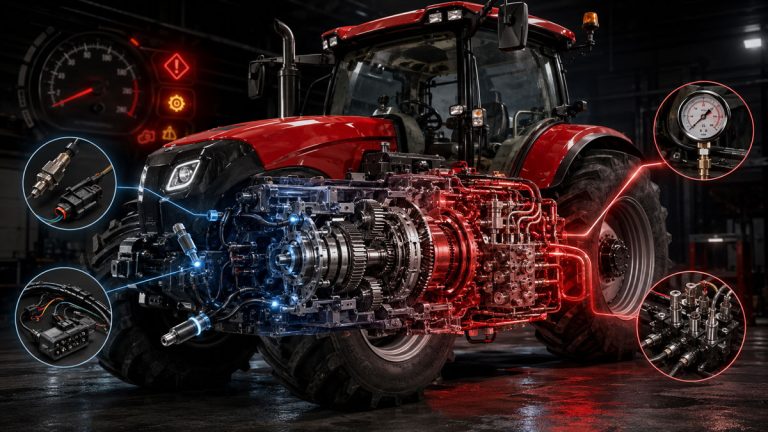
CNH will begin releasing revised engine software in the fourth quarter of 2026 that gives operators more time to address certain emissions-system faults before an engine derate is triggered.
The software is being developed in response to updated U.S. Environmental Protection Agency guidance covering emissions-system fault inducement timing. CNH says the first updates will target high-horsepower agricultural equipment, with additional product families and applications scheduled to receive revised software during 2027.
For Case IH owners, the important change is not the emissions limits themselves. The update changes what can happen after the machine detects certain emissions-system problems and before the engine reaches a severe power restriction.
More Time to Repair Emissions Faults
Modern diesel equipment uses inducement strategies to ensure that faults affecting emissions-control systems are repaired.
When certain DEF, SCR or related emissions faults remain unresolved, the engine control system can progressively restrict machine performance. Depending on the fault and calibration, that can eventually leave an operator with severely reduced engine power.
The problem for agricultural equipment is timing.
A fault that develops during planting or harvest can require parts, diagnostic work or dealer assistance that cannot always be completed immediately. A rapid progression toward a severe derate can therefore turn an emissions-system fault into machine downtime during a critical field operation.
CNH says its revised software will provide additional time to plan and complete repairs before certain engine derates are triggered.
The fault itself is not being eliminated, and the update does not allow operators to ignore a malfunction indefinitely. Instead, the revised strategy changes the time available to respond to certain detected problems.
Case IH High-Horsepower Equipment Comes First
CNH has not yet published a complete model-by-model compatibility list.
The company has confirmed that the initial Q4 2026 rollout will prioritize high-horsepower agricultural equipment. Additional product families will be added throughout 2027.
That is relevant to Case IH because CNH’s agricultural brands include Case IH, New Holland and STEYR. However, until CNH or Case IH publishes specific model and engine eligibility information, owners should not assume that every Case IH tractor or combine will receive the update at the same time.
Software availability may depend on machine family, engine configuration, model year and existing controller software.
Owners Will Be Able to Install Updates With EST
One of the more important details in CNH’s announcement concerns installation.
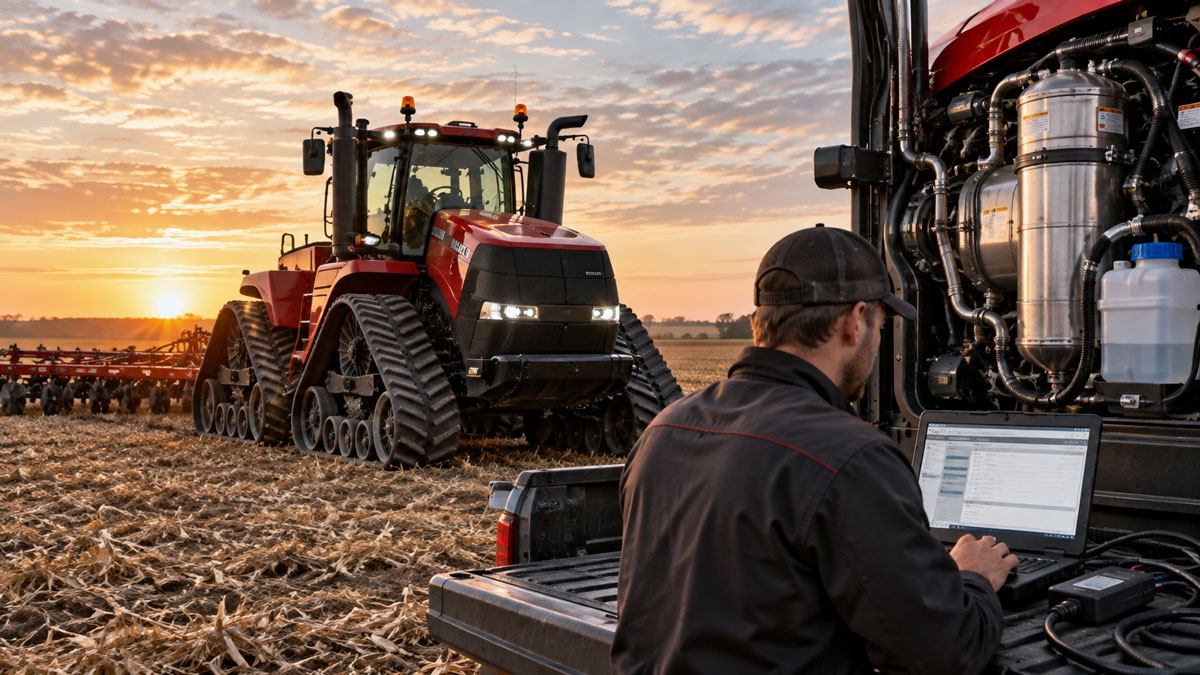
Customers with a CNH Electronic Service Tool subscription will be able to perform the software update themselves once the appropriate software becomes available. Dealers will also be able to support installation remotely or on site.
Case IH EST connects a Windows PC to the machine’s CAN network through a protocol adapter. Its supported functions include controller status and software-version retrieval, parameter monitoring, fault-code retrieval and clearing, service information, electrical and hydraulic schematics, and diagnostic procedures.
Case IH also offers a Remote Service Tool as an extension of EST. On supported connected machines, it can retrieve and clear fault codes, collect CAN parameters, update supported machine configurations and receive software updates remotely.
That means some owners may not need to wait for a physical dealer visit solely to install the new emissions calibration.
What Changes When a DEF or SCR Fault Appears?
The announcement does not mean DEF and SCR faults will stop producing warnings or fault codes.
The machine still needs to detect emissions-system malfunctions, alert the operator and comply with applicable emissions requirements.
What changes is the inducement timing associated with certain faults.
For an owner, the practical sequence could therefore become: Emissions fault detected → warning and fault code → diagnosis → additional repair window → repair → severe derate if the qualifying problem remains unresolved.
The additional time could be particularly useful when a fault requires a replacement sensor or another component that is not immediately available.
It could also give technicians more opportunity to diagnose the actual cause instead of replacing components simply to avoid an approaching derate.
A DEF Fault Does Not Always Mean the DEF System Component Has Failed
The longer repair window is useful because emissions faults can require more diagnosis than their descriptions initially suggest.
An SCR or DEF-related fault can potentially involve sensors, wiring, connectors, dosing equipment, pumps, heaters, fluid quality, NOx monitoring or other parts of the aftertreatment system.
Electrical problems can further complicate diagnosis.
For example, a controller reporting an implausible sensor signal does not automatically prove that the sensor itself has failed. The technician may need to check supply voltage, ground, wiring integrity and connector condition before replacing the component.
Clearing the fault code without repairing the underlying condition is also unlikely to solve the problem. If the controller detects the same condition again, the fault can return.
Additional time before a severe derate therefore does not reduce the need for proper diagnosis. It can provide a larger window in which that diagnosis and repair can be completed.
The Update Follows New EPA Guidance
CNH says the revised engine software is being developed specifically to align with updated EPA guidance concerning emissions-system fault inducement timing.
This is an important distinction.
The change is not CNH removing DEF/SCR protections from its equipment. The company is modifying its software strategy within the framework of updated U.S. regulatory guidance.
CNH’s announcement also confirms that the changes are now moving beyond regulatory guidance and into actual OEM software development.
For Case IH owners, that is more significant than the earlier EPA announcement alone because there is now a confirmed CNH implementation schedule.
Existing Machines Are the Important Question
The next detail to watch is the eligibility list.
CNH has confirmed the Q4 2026 start, the priority for high-horsepower agricultural equipment and the broader rollout during 2027, but it has not yet identified all supported Case IH models or model years.
Owners should therefore wait for machine-specific information before assuming that a particular Steiger, Magnum, Optum, Puma, combine or other Case IH machine is eligible.
The fact that CNH specifically says customers with EST subscriptions will be able to install the software is significant, however. It indicates that at least part of the program involves updating equipment already in service rather than limiting the revised strategy to newly manufactured machines.
What Case IH Owners Should Do
There is no reason to change anything on a machine before the appropriate software is officially released.
Owners experiencing DEF, SCR or other aftertreatment faults should continue diagnosing and repairing them according to the correct service information for the machine.
When the new calibrations become available, the important things to verify will be the machine model, model year or serial-number range, engine configuration, current software version and whether the update can be installed through EST or remotely through an authorized dealer.
Case IH already makes EST available to customers as part of its self-repair program. The system supports controller information, parameter monitoring and fault-code troubleshooting, while connected machines can also use remote diagnostic capabilities through Case IH’s service infrastructure.
What This Means for Case IH Diagnostics
The change should not make DEF and SCR fault codes less important.
It should make the period after a qualifying fault occurs more manageable.
Instead of facing a severe engine restriction within the previous inducement schedule, affected owners may have additional time to retrieve the fault codes, inspect the emissions system, test the relevant sensors and circuits, obtain required parts and complete the repair.
That is especially important in agriculture, where losing a high-horsepower tractor or combine during a short operating window can have consequences far beyond the repair itself.
The next major piece of information will be CNH’s machine-specific rollout details. Once Case IH model eligibility and software versions are published, owners will be able to determine exactly which machines can receive the revised derate strategy.
CNH plans to begin that process in Q4 2026, followed by additional equipment throughout 2027.
Source: cnh.com