Case IH Farmall 100C Repeated DEF Faults and Limp Mode. What to Diagnose Before Replacing Parts
Some Case IH Farmall 100C owners run into a cluster of DEF issues on the same tractor: coolant showing up in the DEF tank, “DEF poor quality” derates, a “DEF frozen” alert popping up in warm weather, injection failure messages, and limp mode kicking in again and again. It’s a rough experience, and understandably it pushes some owners toward the idea of just deleting the emissions system and being done with it.
Worth slowing down before going that route, though. Pulling SCR/DEF hardware off an emissions-certified machine is illegal under EPA rules for off-road diesel equipment, it kills your warranty, and it often voids insurance too — and none of that actually tells you what’s wrong. Five fault messages that look unrelated, showing up on one machine, usually point to one or two root causes working their way through a shared system rather than five separate parts failing independently. The real question is where in the DEF/SCR chain this is starting, and what order to check things in.
Emissions Architecture on the Farmall 100C
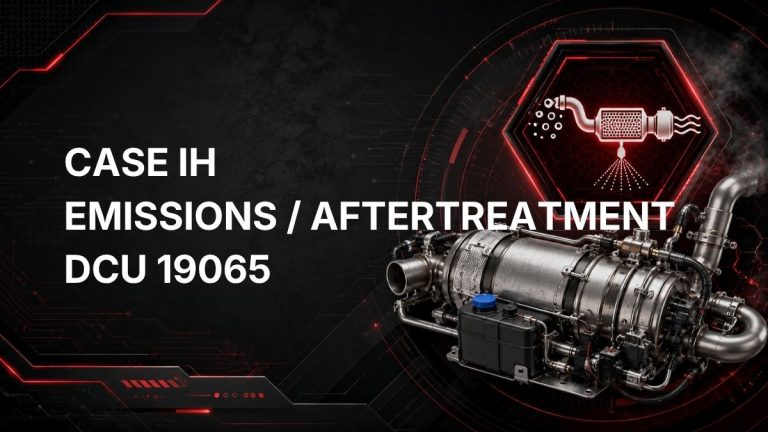
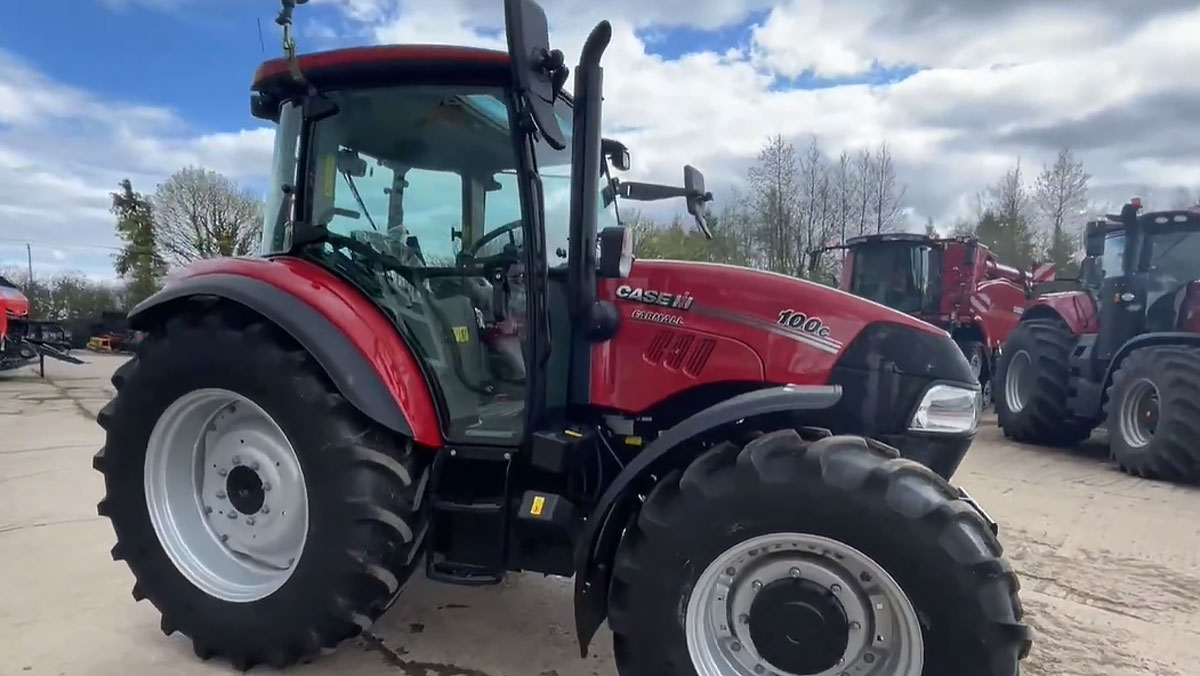
Under the hood, the Farmall 100C uses a 4-cylinder, 3.4-liter FPT common-rail diesel making roughly 99 hp, meeting Tier 4B/Final standards through internal Cooled Exhaust Gas Recirculation (CEGR) paired with Selective Catalytic Reduction (SCR). No diesel particulate filter, no regeneration cycle — the CEGR system handles that side of things on its own. That absence matters for diagnosis: there’s no “force a regen” step to help rule things in or out here, unlike on DPF-equipped machines. So basically, any warning on this tractor comes from either the CEGR loop or the SCR/DEF system — nothing else it could be. DEF tank capacity sits at 2.8 gallons (10.6 L).
DEF/SCR System Layout
Splitting the SCR system into its functional components helps before jumping into symptoms, because a warning that sounds like it’s about one thing (quality, freezing, injection) can actually be coming from somewhere else entirely:
- DEF tank assembly — the tank, a heater loop that runs engine coolant through or around it via a control valve, and a combined level/quality/temperature sensor sitting in the tank head.
- Delivery circuit — pump, filter, lines, all moving DEF from the tank to the dosing point at a controlled pressure.
- Dosing/injection module — the injector that meters DEF into the exhaust stream just ahead of the SCR catalyst.
- SCR catalyst and NOx sensors — the catalyst plus inlet/outlet NOx sensors confirming the reaction is actually converting NOx like it should.
The DEF head is what delivers fluid of the right quality, quantity, and temperature into the exhaust stream before it hits the SCR, and when levels drop or the fluid goes bad, that same head tells the ECU to light up a warning. Here’s the catch: level, quality, and temperature sensing, along with the heater valve, all live in the same physical housing. Which is exactly why a coolant leak affecting the heater function can throw off quality readings too — looks like a chemistry problem on the dash, but it’s mechanical underneath.
Why These Symptoms Aren’t Necessarily Separate Failures
Take the typical sequence — coolant intrusion, then quality faults, then a frozen-DEF warning in weather nowhere near freezing, then injection trouble, then limp mode. Read that as one contamination event rippling outward rather than a list of unrelated breakdowns.
Coolant leak into the DEF tank. DEF tank heaters keep fluid from freezing by circulating engine coolant through the tank, and when the heater valve or its lines fail, that coolant ends up in the DEF itself. Shine a light in the tank — anything other than clear liquid means trouble, and it’ll mess with the level and quality sensors sitting right there in the tank head. This is very often where everything else starts.
The “poor quality” faults that follow. Coolant mixing in dilutes or chemically alters the DEF, pushing urea concentration outside the roughly 32.5% range the sensor expects. The ECU isn’t wrong to flag that — it’s reading real contamination. Swap the sensor without fixing the coolant source, though, and you’re just buying time before it happens again.
A “DEF frozen” fault when it’s nowhere near freezing. Honestly, this one’s the biggest tell. A frozen-DEF code showing up when both ambient and coolant temps make actual freezing impossible points squarely at the temperature sensor misreading — again, likely tied to contamination or a wiring issue in that same tank-head unit — rather than any real thermal event.
Injection failure and limp mode. Further downstream, the pump, filter, or doser can pick up debris or crystallized buildup from degraded fluid, which shows up as delivery or dosing faults. SCR systems generally escalate unresolved faults through a staged inducement sequence: warning first, then a derate, then idle-only or low-speed limp mode, so the fault can’t just be ignored. On this Farmall C-series platform specifically, reported faults have included SCR tampering warnings, staged SCR warning levels, and torque limiting from the inducement logic — and codes can come right back after clearing if the inducement counter itself never got reset properly. That last part trips people up a lot: a genuinely good repair, followed by a derate returning anyway because nobody reset the counter.
Diagnostic Sequence Before Replacing Parts
Given all that, working from the tank outward — ruling out contamination before touching anything downstream, tends to be the efficient path:
- Look at the DEF and test it. Check for cloudiness, discoloration, an oily sheen — any of it. Confirm concentration with a refractometer (should read around 32.5% urea). Found contamination? Drain, flush, refill with fresh fluid. Topping it off isn’t enough.
- Leak-test the heater coolant circuit, specifically at the tank heater valve and its lines, since that’s the most common place contamination actually starts. Make sure the valve isn’t stuck or leaking, and that supply/return lines haven’t been crossed.
- Pull sensor readings through CNH’s diagnostic software (EST) rather than trusting the dashboard warnings alone. Live level, quality, and temperature data will show you whether a reading is physically impossible — a “frozen” code in warm weather, for instance — which tells you it’s sensor/wiring, not fluid.
- Check the doser and delivery lines for crystallized buildup, but only once fluid quality checks out clean. Dosing-side symptoms downstream of a contamination event often clear up on their own once the source is dealt with.
- Make sure the inducement/derate counter actually gets reset after any repair — through the dealer tool’s SCR inducement reset function, not just a plain code clear. Otherwise a valid fix gets followed by a derate that never should’ve come back.
- and aftertreatment calibrations periodically, and a machine with this kind of history is worth checking against the current release rather than assuming it’s still on the original software.
What to Ask the Dealer For
Fair to ask for documentation — actual fault codes, not just dashboard messages — logged at each visit. And worth asking directly whether an original coolant-in-DEF-tank problem ever got traced to a root cause and properly fixed, versus just drained and refilled. If the tank head, heater valve, or sensor module never got replaced after a coolant intrusion, that’s probably why the same fault keeps resurfacing wearing different labels each time. Exact SPN/FMI codes, applicable service bulletins, and PIN-specific software revisions should be confirmed against current Case IH service literature or CNH EST output for the actual machine in question — these details shift between production runs more than people expect.